
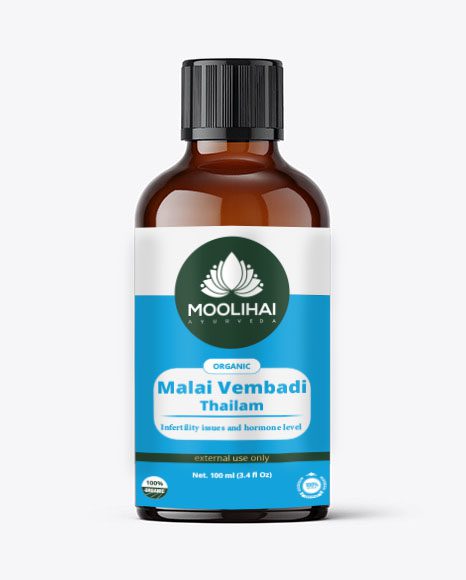
Malai Vembathi Thailam 100ml | Herbal Oil
24.99$
Weight: 100 ml (3.4 fl oz)
Origin: India
Out of stock
Malai Vembadi Thailam · Siddha Herbal Oil · Women’s Hormonal Balance · 100 ml (3.4 fl oz)
The Siddha Medicine Women Have Used for Centuries — For Hormonal Balance, Regular Cycles & Reproductive Wellness
Malai Vembadi Thailam is a classical Siddha oral herbal oil formulation designed specifically for women’s hormonal and reproductive health. In the Siddha medical tradition — the oldest documented medical system in the world, originating in Tamil Nadu over 2,000 years ago — “thailam” (oil-based medicine) is one of the most effective delivery systems for herbal compounds, because the oil base carries fat-soluble phytochemicals directly into the bloodstream and reproductive tissues with high bioavailability. This particular formulation combines neem leaf extract (Malai Veppilai), Kummatti fruit juice, Venoaya extract, fresh lemon juice (Elumichcham Pazha Saru), and castor oil (Amanakku Ennai) — each selected for its documented action on the female endocrine system. It has been traditionally prescribed by Siddha practitioners and recommended by gynaecologists for irregular menstrual cycles, PCOS/PCOD, hormonal imbalance, and as a supporting therapy for fertility. This is a practitioner-grade Siddha medicine — not a cosmetic oil or food supplement — prepared according to classical Siddha formulation methods. $24.99 for 100ml.
Classical Siddha Formulation
100% Herbal · No Chemicals
Oral Herbal Medicine
Ships via DHL / UPS
A Classical Siddha Oil for Women’s Hormonal Health
In Siddha medicine, “thailam” (oil preparation) is not a cooking oil or a massage oil — it is a precisely formulated oral medicine where herbal extracts are processed into an oil base through specific heating, infusion, and filtration methods that have been documented in Siddha texts for over 2,000 years. The oil base serves a critical pharmacological function: it acts as a lipophilic carrier that transports fat-soluble herbal compounds across the intestinal membrane and into the bloodstream with far greater bioavailability than water-based preparations (kashayam/decoctions). For hormonal and reproductive conditions, this is especially important because the steroid hormones involved (oestrogen, progesterone, testosterone) are themselves fat-soluble molecules — so the oil-based delivery system targets the same biological pathways. Malai Vembadi Thailam has been prescribed by Siddha practitioners (Siddha Vaithiyars) and increasingly recommended by gynaecologists in Tamil Nadu and South India as a complementary therapy for women experiencing hormonal imbalance, irregular menstrual cycles, PCOS/PCOD, and fertility challenges. It is taken orally — 5 to 10ml twice daily after meals — as part of a broader treatment protocol that typically includes dietary and lifestyle modifications.
Five Herbal Components, One Synergistic Formula
Malai Veppilai Sam
Neem leaf extract (Azadirachta indica) — the cornerstone ingredient. Neem is one of the most pharmacologically studied plants in Indian medicine, with over 140 identified bioactive compounds including nimbin, nimbidin, and azadirachtin. In women’s health, neem has documented anti-androgenic properties — it helps regulate excess androgen (male hormone) levels, which is the primary hormonal driver behind PCOS/PCOD symptoms including irregular periods, acne, hirsutism (excess facial hair), and ovulatory dysfunction. Neem also has anti-inflammatory and immunomodulatory effects that address the chronic low-grade inflammation associated with hormonal disorders.
Kummatti Kai Saru
Kummatti fruit juice — a traditional Siddha ingredient used specifically in reproductive medicine formulations. In Siddha pharmacology, Kummatti Kai is classified as a uterine tonic (Garbhashaya Balya) that supports the health and function of the uterus and ovaries. It is traditionally used to promote regular ovulation, strengthen uterine lining, and support the body’s natural menstrual rhythm. The juice extract is processed into the oil base to ensure optimal extraction of its active phytochemicals.
Venoaya Saru
Venoaya extract — another classical Siddha ingredient with specific action on the female reproductive system. In traditional Siddha texts, Venoaya is documented for its ability to support endocrine balance and promote healthy menstrual flow. It works synergistically with the neem extract and Kummatti Kai to address hormonal imbalance from multiple angles simultaneously — a foundational principle in Siddha formulation called “Koottu Marundhu” (combination medicine), where ingredients are selected to complement and enhance each other’s therapeutic effects.
Elumichcham Pazha Saru
Fresh lemon juice (Citrus limon) — serves dual roles in this formulation. First, the citric acid and vitamin C act as natural bioavailability enhancers, improving the absorption of iron and other minerals from the herbal extracts. Second, lemon juice is classified in Siddha medicine as a “Pitta-balancing” ingredient that supports liver function — and the liver is the organ primarily responsible for metabolising and clearing excess hormones from the body. Healthy liver function is essential for hormonal balance, and lemon juice supports the hepatic detoxification pathways involved in oestrogen metabolism.
Amanakku Ennai (Castor Oil)
Castor oil (Ricinus communis) — the base oil of the formulation. Castor oil is not merely a carrier; it is itself a therapeutic ingredient in Siddha medicine, classified as a “Mala Shodhana” (bowel cleanser) and “Vata Shamaka” (Vata dosha pacifier). In women’s health specifically, castor oil has been used for centuries to support pelvic circulation, reduce pelvic congestion, and promote the elimination of toxins through the bowels. Its ricinoleic acid content (approximately 90% of the fatty acid profile) has documented anti-inflammatory and analgesic properties that may help reduce menstrual pain and pelvic discomfort.
What Siddha Practitioners Prescribe It For
Hormonal Balance
The primary traditional indication for Malai Vembadi Thailam is hormonal imbalance — the condition where the body’s endocrine system produces too much or too little of specific hormones, disrupting the delicate balance that regulates menstrual cycles, ovulation, mood, energy, skin health, and body weight. In women, the most common form is excess androgens (male hormones) relative to oestrogen and progesterone, which manifests as irregular periods, acne, weight gain (especially around the abdomen), thinning hair on the scalp, and excess hair growth on the face and body. The herbal compounds in this formulation — particularly the neem extract — have anti-androgenic properties that help the body restore its natural hormonal equilibrium over time. This is not a quick fix; Siddha practitioners typically prescribe it for 2–3 month cycles to allow the endocrine system to recalibrate gradually.
Irregular Menstrual Cycles
Irregular periods — cycles that are consistently shorter than 21 days, longer than 35 days, or that vary unpredictably in length — affect an estimated 14–25% of women of reproductive age. Causes include PCOS/PCOD, thyroid dysfunction, stress, excessive exercise, rapid weight changes, and perimenopause. In Siddha medicine, menstrual irregularity is understood as a disruption of “Kala” (timing/rhythm) in the reproductive system, and treatment focuses on restoring the body’s natural cyclical pattern through herbal support. Malai Vembadi Thailam is traditionally used to promote regular ovulation and consistent cycle length, supporting the hypothalamic-pituitary-ovarian axis — the hormonal feedback loop that governs the menstrual cycle.
PCOS / PCOD Support
Polycystic Ovary Syndrome (PCOS) and Polycystic Ovarian Disease (PCOD) are the most common endocrine disorders in women of reproductive age, affecting an estimated 8–13% of women globally — with some studies suggesting even higher prevalence in South Asian populations. The condition is characterised by multiple small cysts on the ovaries, elevated androgen levels, insulin resistance, and irregular or absent ovulation. Conventional treatment typically involves hormonal contraceptives, metformin, and/or anti-androgens. Malai Vembadi Thailam has been traditionally used by Siddha practitioners as a complementary therapy alongside or as an alternative to conventional PCOS management, with the neem-based formulation specifically targeting the androgen excess and inflammatory components of the condition.
Fertility Support
For women experiencing difficulty conceiving, Siddha practitioners have traditionally prescribed Malai Vembadi Thailam as part of a broader “Garbhini Paricharya” (pre-conception care) protocol. The rationale is that by addressing underlying hormonal imbalance, restoring regular ovulation, and optimising uterine health, the body’s natural fertility is enhanced. This is particularly relevant for women whose fertility challenges stem from PCOS/PCOD-related anovulation (absence of ovulation), where restoring regular ovulatory cycles is the key to natural conception. Important: fertility treatment is complex and multifactorial — this oil is a supporting therapy, not a standalone fertility treatment. Always work with a qualified gynaecologist or fertility specialist alongside any herbal medicine.
Menstrual Comfort
Beyond cycle regularity, this formulation is traditionally used to address the quality of menstruation — reducing excessive heaviness (menorrhagia), alleviating severe cramping (dysmenorrhea), and normalising flow duration. The castor oil base provides anti-inflammatory and analgesic effects through ricinoleic acid, while the herbal extracts work on the upstream hormonal drivers that cause problematic menstruation. In Siddha understanding, painful and heavy periods are symptoms of underlying “Vata-Pitta” imbalance in the reproductive system, and this thailam is formulated to restore equilibrium to both doshas simultaneously.
Metabolic & Blood Sugar Support
The product description notes use for diabetes management — and this makes pharmacological sense. PCOS and insulin resistance are deeply interconnected: 50–70% of women with PCOS also have insulin resistance, and the two conditions drive each other in a vicious cycle (excess insulin stimulates androgen production, and excess androgens worsen insulin resistance). Neem has well-documented hypoglycaemic properties — multiple studies show that neem leaf extract reduces fasting blood glucose and improves insulin sensitivity. By addressing both the hormonal and metabolic components of PCOS simultaneously, this formulation targets the root cause rather than individual symptoms.
Dosage & Administration
Standard Oral Dose — After Meals
The recommended dosage is 5 to 10ml of Malai Vembadi Thailam taken orally, twice daily, after meals. Use a measuring spoon or the cap of the bottle to ensure accurate dosing. Take it after food — not on an empty stomach — to ensure the oil is absorbed along with dietary fats for maximum bioavailability, and to prevent any stomach discomfort. The oil has a herbal, slightly bitter taste (from the neem) with a citrus note (from the lemon juice). If the taste is difficult, you can follow it immediately with a sip of warm water or warm milk. Do not mix it into hot food or beverages, as excessive heat may degrade some of the heat-sensitive phytochemicals.
Duration — Minimum 2–3 Month Cycle
Hormonal conditions do not resolve overnight — and neither does herbal treatment. Siddha practitioners typically prescribe Malai Vembadi Thailam for a minimum of 2–3 continuous months (60–90 days) to allow sufficient time for the herbal compounds to accumulate in the body, modulate the endocrine system, and produce observable changes in menstrual regularity and hormonal markers. Some practitioners recommend 3–6 month treatment courses for chronic PCOS/PCOD. Do not expect immediate results after the first dose — the therapeutic effect builds cumulatively over weeks. Track your menstrual cycle dates, symptoms, and any changes during the treatment period so you can assess progress objectively with your healthcare provider.
Consult Your Gynaecologist
This is a practitioner-grade Siddha medicine, not a general wellness supplement. While the natural ingredients make it generally safe, hormonal and reproductive conditions are complex and require professional oversight. We strongly recommend consulting your gynaecologist or a qualified Siddha practitioner before starting Malai Vembadi Thailam — especially if you are: currently on hormonal medication (birth control pills, HRT), taking metformin or other diabetes medication, undergoing fertility treatment (IUI, IVF), pregnant or actively trying to conceive (some herbal compounds may not be suitable during pregnancy), or breastfeeding. Your doctor can advise on appropriate dosage, duration, and whether this oil is compatible with your existing treatment plan.
Supporting Lifestyle — Diet & Exercise
In Siddha medicine, herbal treatment is always prescribed alongside dietary and lifestyle modifications — the medicine is one component of a holistic approach. For hormonal balance and PCOS management, Siddha practitioners typically recommend: reducing refined sugar and processed carbohydrates (which spike insulin and worsen androgen excess), increasing whole grains and millets (Moolihai’s Millet range provides traditional options), incorporating anti-inflammatory spices (turmeric, ginger, fenugreek — all available from Moolihai), maintaining regular physical activity (30 minutes daily), managing stress (which directly disrupts the hypothalamic-pituitary-ovarian axis), and ensuring adequate sleep (7–8 hours). The oil works best when your body is also being supported through these fundamental health practices.
Names & Classification
Tamil
மலை வேம்படி தைலம் (Malai Vembadi Thailam)
English
Women’s Hormonal Balance Oil
Medical System
Siddha Medicine (Siddha Vaithiyam)
Category
Thailam (Oil-Based Internal Medicine)
Primary Use
Women’s Hormonal & Reproductive Health
Administration
Oral — taken by mouth after meals
Key Herb
Neem (Azadirachta indica)
Base Oil
Castor Oil (Amanakku Ennai)
What You’re Getting
100 ml (3.4 fl oz)
Single bottle
Herbal Oil
Oral liquid medicine
India
Origin — Tamil Nadu Siddha tradition
Siddha Formulation
Classical preparation method
5–10 ml Dose
Twice daily after meals
No Chemicals
100% herbal ingredients
~10–20 Day Supply
At recommended dosage
$24.99
100 ml bottle
Ships Worldwide
USA
5–7 Days
FREE OVER $99
UK
5–7 Days
FREE OVER $99
Canada
5–7 Days
FREE OVER $99
Ships worldwide via DHL/UPS. Shipping info →
Common Questions
Conventional PCOS treatment typically involves three categories of pharmaceutical drugs: hormonal contraceptives (birth control pills) to regulate cycles and suppress androgens, metformin to address insulin resistance, and anti-androgens (spironolactone) to reduce excess male hormones. These are effective but come with well-documented side effects — weight gain, mood changes, nausea, liver stress, and in the case of contraceptives, suppression of natural ovulation (which is counterproductive if you’re trying to conceive). Malai Vembadi Thailam takes a fundamentally different approach: rather than overriding the hormonal system with synthetic hormones, it uses herbal compounds — particularly neem’s anti-androgenic and insulin-sensitising properties — to support the body’s own endocrine system in restoring balance naturally. The trade-off is speed: pharmaceuticals produce faster symptomatic relief, while herbal treatment works more gradually (2–3+ months) but addresses root causes. Many women use both approaches together — consult your gynaecologist about integrating this oil into your existing treatment plan.
This is one of the traditional uses of Malai Vembadi Thailam — supporting natural fertility by restoring regular ovulation in women with PCOS-related anovulation. However, fertility is a nuanced medical situation, and we strongly recommend working with a qualified gynaecologist or fertility specialist before and during use. Before conception: the oil is traditionally used in the pre-conception phase to regulate cycles and promote ovulation. During active conception attempts: consult your doctor about whether to continue during the two-week wait (the period between ovulation and expected period). Once pregnant: stop taking the oil and inform your doctor. Neem and castor oil are not recommended during pregnancy. The safest approach is to use this oil as part of a supervised pre-conception protocol, with your doctor guiding when to start and stop based on your cycle tracking and fertility treatment timeline.
Hormonal rebalancing is a gradual process — there is no overnight fix for conditions that have been developing over months or years. Based on traditional Siddha practice, the typical timeline is: Weeks 1–2: No dramatic changes expected. The herbal compounds are accumulating in your system. You may notice subtle improvements in energy or digestion (from the castor oil’s bowel-regulating effect). Weeks 3–6: Some women begin to notice changes in their next menstrual cycle — slightly more predictable timing, reduced severity of PMS symptoms, or improved menstrual flow. Months 2–3: More consistent cycle regularity, reduction in hormonal acne, and measurable changes in hormonal markers if blood tests are taken. Months 3–6: Optimal results for chronic conditions like PCOS/PCOD. Siddha practitioners typically reassess at the 3-month mark and adjust the treatment plan. Track your cycles, symptoms, and any changes from day one — this data is invaluable for your doctor to evaluate progress.
The herbal ingredients in Malai Vembadi Thailam have a long history of traditional use and are generally well-tolerated. The castor oil base may cause mild laxative effects in the first few days, particularly at the higher dose (10ml twice daily) — this is normal and typically resolves as the body adjusts. Start with the lower dose (5ml twice daily) for the first week. The neem imparts a bitter taste that some people find unpleasant — follow with warm water or milk. Important contraindications: Do not take during pregnancy (neem and castor oil are not safe during pregnancy). Do not take while breastfeeding without medical advice. If you are on blood-thinning medication, consult your doctor (neem has mild anticoagulant properties). If you experience any allergic reaction (rash, itching, swelling), discontinue immediately and consult a doctor. If you have a known allergy to neem or castor oil, do not use this product.
Store the bottle in a cool, dry, dark place — away from direct sunlight and heat sources. Do not refrigerate unless specifically advised by your Siddha practitioner, as the castor oil base may thicken excessively at cold temperatures and become difficult to pour. Keep the cap tightly sealed after each use to prevent oxidation. The herbal oil is best used within 6–12 months of manufacture. You’ll know it’s still good by the characteristic herbal smell and consistent oil colour — if it develops an off/rancid smell or visible sediment, discard it. At the recommended dosage of 10ml twice daily (20ml per day), a 100ml bottle provides approximately 5 days of supply. For a full 2–3 month treatment course, you would need 12–18 bottles — consider contacting Moolihai for bulk or wholesale pricing.
Siddha medicine is one of the oldest documented medical systems in the world, originating in Tamil Nadu, South India, with written records dating back over 2,000 years. It is one of the three traditional Indian medical systems recognised and regulated by the Government of India’s Ministry of AYUSH (Ayurveda, Yoga, Unani, Siddha, Homeopathy). Siddha practitioners undergo formal university education — a 5.5-year BSMS (Bachelor of Siddha Medicine and Surgery) degree followed by clinical internship — and are licensed to practice by the Central Council of Indian Medicine. Siddha medicine has its own pharmacopoeia, formulary, and quality standards. Malai Vembadi Thailam is a classical Siddha formulation — meaning it’s documented in traditional Siddha texts and prepared according to established methods, not an improvised or modern invention. While Siddha treatments may not always have the randomised controlled trial evidence that modern pharmaceuticals do, they represent millennia of clinical observation and refinement, and many Siddha herbs (including neem) now have substantial modern scientific validation.
*Disclaimer: Malai Vembadi Thailam is a traditional Siddha herbal oil preparation. The health benefits and traditional uses described are based on classical Siddha medical texts and traditional practitioner experience. This product has not been evaluated by the United States Food and Drug Administration, European Medicines Agency, or Indian Medical Association. It is not intended to diagnose, treat, cure, or prevent any disease. PCOS/PCOD, hormonal imbalance, irregular menstruation, infertility, and diabetes are complex medical conditions that require professional diagnosis and monitoring. Always consult a qualified gynaecologist, endocrinologist, or Siddha practitioner before starting this product. Do not use during pregnancy or breastfeeding. Do not use if you have a known allergy to neem or castor oil. Do not discontinue prescribed medication without your doctor’s approval. Individual results may vary. This product is a complementary therapy and should not replace conventional medical treatment.
| Weight | .1 kg |
|---|
Be the first to review “Malai Vembathi Thailam 100ml | Herbal Oil”
You must be logged in to post a review.
Related products


Reviews
There are no reviews yet.