
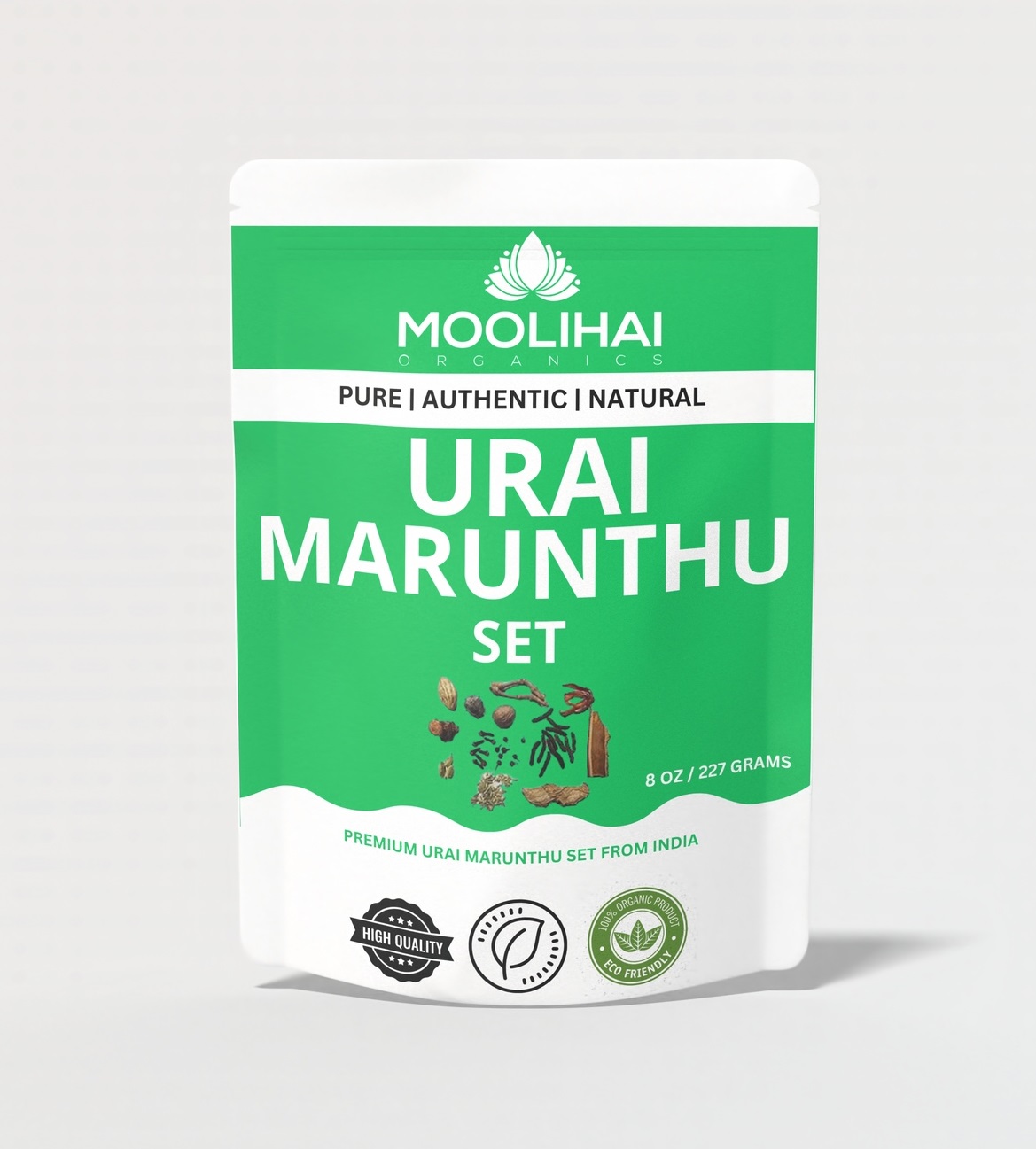
Urai Marunthu Set | Traditional Medicine Kit for Babies | Natural Ingredients – 1 Pack
16.00$
Urai marunthu can be given to babies from the age of 1 month to 7 years to secure them from various health issues.
Urai Marunthu · Traditional Tamil Baby Medicine Kit · 5-Herb Grinding Set · Ages 1 Month – 7 Years
Your Grandmother’s Baby Medicine — The 5-Herb Grinding Kit That Tamil Families Have Trusted for Generations
Before paediatric clinics, before pharmaceutical syrups, before baby wellness aisles in supermarkets — there was the Urai Marunthu. In traditional Tamil households, every grandmother knew how to prepare this: five specific herbs, a grinding stone (urai kal), a few drops of breast milk, and a baby’s tiny tongue. The Urai Marunthu set is a classical Tamil baby care kit containing five raw herbal ingredients — Maasikai (Oak Nut), Vasambu (Sweet Flag), Kadukkai (Ink Nut/Haritaki), Jathikai (Nutmeg), and Perungayam (Asafoetida) — each selected over centuries of observational use for specific aspects of infant health: digestion, appetite, immunity, teething, colic, and respiratory comfort. The herbs arrive in their raw, whole form. The parent grinds a small portion on a stone mortar with breast milk or water, producing a thin herbal paste that is given to the baby in tiny amounts. This is the same method — the same five herbs, the same preparation technique, the same stone-grinding ritual — that Tamil mothers and grandmothers have practised for centuries. For diaspora families who grew up watching their paati (grandmother) prepare this and now want to continue the tradition with their own children, this kit is a direct connection to home.
Traditional Tamil Baby Care Kit
5 Raw Herbs · 100% Natural
Ages 1 Month – 7 Years
Ships via DHL / UPS
Each Herb, a Specific Role — Together, a Complete Infant Wellness System
Kadukkai — Ink Nut (Haritaki)
Terminalia chebula — one of the three fruits in the legendary Ayurvedic formula Triphala, and the single most revered herb in Siddha medicine (called “Kayakalpa” — the rejuvenator). In infant care, Kadukkai serves as a gentle blood purifier and digestive regulator. It helps remove toxins from the baby’s system, promotes healthy digestion, increases appetite, treats constipation without harsh laxative effects, and supports liver function. The tannins and chebulic acid in Kadukkai have documented antimicrobial and antioxidant properties. In the Urai Marunthu tradition, Kadukkai is the foundational herb — it creates the clean internal environment on which the other four herbs can work most effectively.
Maasikai — Oak Nut (Majuphal)
Quercus infectoria — a gall-rich nut with particularly strong astringent and antimicrobial properties. In traditional Tamil baby care, Maasikai is specifically associated with teething support and oral health. It strengthens the gums, promotes healthy teeth eruption, and treats the white coating on the tongue that is common in breastfed infants (oral thrush/Candida). The tannins in Maasikai have documented antifungal activity that addresses the Candida overgrowth responsible for white tongue. It also helps with gastric issues, urinary health, and appetite stimulation in infants. Maasikai is the herb Tamil grandmothers most associate with “strong teeth and clean tongue.”
Jathikai — Nutmeg
Myristica fragrans — the aromatic spice that serves double duty in infant care: digestive support AND sleep promotion. Nutmeg has documented carminative properties — it reduces gas, bloating, and the colic that makes babies cry inconsolably. It also has mild sedative properties (from myristicin and other volatile compounds) that promote restful sleep in fussy, restless infants. In the Urai Marunthu tradition, Jathikai is the “comfort herb” — it settles the stomach and calms the nervous system simultaneously. The amount used in the grinding preparation is extremely small (as it should be — nutmeg is potent and must be used in tiny infant-appropriate doses), providing gentle therapeutic benefit without any risk of overstimulation.
Vasambu — Sweet Flag (Calamus)
Acorus calamus — perhaps the most iconic herb in Tamil baby care. “Vasambu kattu” (tying a piece of sweet flag root to the baby’s wrist or waist) is a universal Tamil tradition for newborns. In the Urai Marunthu set, Vasambu is taken internally as part of the grinding paste. It is the most versatile herb in the kit: it boosts infant immunity, cleans the tongue (improving taste sensation and appetite), treats stomach pain and indigestion, prevents excessive mucus production (reducing respiratory congestion), and supports healthy brain development. Vasambu is considered so effective that the existing product description specifically notes “Vasambu should be rubbed fewer times, as it is more effective” — meaning a smaller dose of Vasambu produces a stronger effect than the other herbs. Use sparingly.
Perungayam — Asafoetida (Hing)
Ferula asafoetida — the pungent resin that every Indian kitchen keeps in a jar and every Indian grandmother applies to a colicky baby’s navel. Perungayam is the anti-colic, anti-gas specialist of the Urai Marunthu kit. Its volatile sulphur compounds are powerful carminatives — they relax intestinal smooth muscle, release trapped gas, and relieve the abdominal distension that causes colicky crying in infants. It also has anti-spasmodic properties that calm the gut, supports respiratory health by loosening phlegm, and helps prevent constipation. In the Urai Marunthu grinding preparation, the small amount of Perungayam provides its gas-relieving benefits internally — complementing the traditional external application of asafoetida paste around the baby’s navel.
The Stone-Grinding Method — Exactly as Your Grandmother Did It
Grind on the Urai Kal (Stone Mortar)
You’ll need a small, flat grinding stone — called an “urai kal” in Tamil — which is the traditional tool for preparing baby medicines. This is a small, smooth stone surface (not the large kitchen grinding stone/ammi kal). Place the herb on the stone and add a few drops of breast milk (preferred, as it adds immunity-boosting compounds) or clean water. Rub the herb back and forth on the stone to produce a thin, smooth paste. The stone grinding is not just tradition — it produces a finer, more bioavailable paste than modern grinding methods because the slow, manual process doesn’t generate heat that could degrade sensitive compounds. Grind each herb separately or together as your Siddha practitioner or grandmother advises.
Dosage — Less Is More for Babies
The amount given to the baby is extremely small — a few drops of the ground paste, not spoonfuls. For infants 1–3 months old, the dose is the tiniest amount (a single drop on the fingertip, placed on the baby’s tongue). For older babies (6 months – 2 years), the dose increases slightly but remains small. For children 2–7 years, the amount can be slightly more generous. Critical: Vasambu (Sweet Flag) should be used in smaller quantities than the other herbs — it is the most potent ingredient in the set and a little goes a very long way. Start with less than you think is needed and observe the baby’s response. The herbs work cumulatively over days and weeks — there’s no need to give large doses.
When to Give — Traditional Schedule
The traditional practice varies by family and region, but common approaches include: giving the ground paste once daily in the morning on an empty stomach, or giving specific herbs for specific symptoms as they arise (Perungayam for gas/colic, Jathikai for sleeplessness, Maasikai for white tongue, Vasambu for appetite and immunity). Some families give Urai Marunthu daily as a preventive practice throughout infancy; others use it only when the baby shows signs of digestive discomfort, colic, or appetite loss. Both approaches are within the traditional framework. The key is consistency (if using daily) or prompt response (if using symptomatically) — and always in tiny, infant-appropriate doses.
Consult Your Paediatrician
Urai Marunthu is a centuries-old tradition that has been used safely by millions of Tamil families — but your baby’s health is too important for assumptions. We strongly recommend discussing this practice with your paediatrician before starting, especially if your baby has any medical conditions, is on medication, was born premature, has allergies, or if you have any concerns whatsoever. A good paediatrician — particularly one familiar with traditional Indian baby care practices — can advise on appropriate timing, dosage, and which herbs are suitable for your specific baby. Many paediatricians in Tamil Nadu are familiar with Urai Marunthu and can provide informed guidance. If your paediatrician is unfamiliar with the practice, a qualified Siddha practitioner (Siddha Vaithiyar) can provide traditional guidance alongside your paediatrician’s medical oversight.
Five Herbs, Raw & Whole
Maasikai (Oak Nut)
Quercus infectoria — teeth, tongue, gums
Vasambu (Sweet Flag)
Acorus calamus — immunity, brain, appetite
Kadukkai (Ink Nut)
Terminalia chebula — digestion, blood, liver
Jathikai (Nutmeg)
Myristica fragrans — colic, gas, sleep
Perungayam (Asafoetida)
Ferula asafoetida — gas, colic, respiratory
Grinding Stone Not Included
You’ll need an urai kal separately
Ages 1 Month – 7 Years
Traditional age range
100% Natural
No chemicals, no preservatives
Ships Worldwide
USA
5–7 Days
FREE OVER $99
UK
5–7 Days
FREE OVER $99
Canada
5–7 Days
FREE OVER $99
Ships worldwide via DHL/UPS. Shipping info →
Common Questions
Urai Marunthu has been used on Tamil infants — including newborns as young as 1 month — for generations. The tradition survives because families observe that it works and doesn’t cause harm when used correctly. However, “correctly” is the operative word: the doses are tiny, the preparation must be clean, and the baby’s individual health must be taken into account. Every baby is different — some are perfectly robust from birth, others may have sensitivities or conditions that require caution. Our recommendation is to consult your paediatrician before starting, begin with the smallest possible dose, observe your baby’s reaction for 24 hours, and increase gradually only if there are no adverse reactions. If your baby was born premature, has low birth weight, has any diagnosed health condition, or is taking medication, always get medical clearance before giving any herbal preparation.
This is common, especially outside India or with paediatricians who aren’t familiar with South Indian traditional practices. Two approaches: 1) Explain the concept simply: “It’s a traditional herbal paste made from five specific dried herbs, ground with breast milk on a stone, given in tiny amounts to support infant digestion and immunity. Families in Tamil Nadu have used it for centuries.” Show them the ingredients list — Terminalia chebula (Haritaki), Quercus infectoria, Acorus calamus, Myristica fragrans (Nutmeg), Ferula asafoetida — and ask if they have any specific concerns about these herbs at infant-appropriate micro-doses. 2) Seek a Siddha practitioner (Siddha Vaithiyar) who can provide traditional guidance on dosage and frequency, and share this guidance with your paediatrician. The two practitioners don’t need to agree on philosophy — they just need to agree that the specific herbs at the specific doses are safe for your specific baby.
The traditional urai kal (small stone mortar) is the preferred tool because it produces a smooth, fine paste without generating heat (which could degrade some compounds). However, if you don’t have one, alternatives include: a small mortar and pestle (ceramic or stone — not wood, which absorbs the herb), or the back of a stainless steel spoon pressed against a clean plate. The key is to produce a very fine, smooth paste with no gritty particles (which could be uncomfortable for the baby to swallow). An electric grinder is not recommended — the high-speed rotation generates heat and processes too much herb at once (you only need a tiny amount per session, not a batch). If you plan to use Urai Marunthu regularly, investing in a small urai kal is worthwhile — they’re inexpensive, last forever, and are the tool designed specifically for this purpose. Moolihai may stock urai kal stones — check the Baby / Mother Care category or contact Moolihai directly.
Some of these herbs have strong, bitter, or pungent tastes (particularly the asafoetida and haritaki) that babies may resist initially. Traditional approaches: 1) Grind with breast milk rather than water — the familiar taste of breast milk makes the herbal paste more acceptable. 2) Apply a tiny amount to the baby’s tongue with your clean finger rather than trying to “feed” it — the baby will taste it and swallow reflexively. 3) Start with the mildest herb (Jathikai/Nutmeg, which has a slightly sweet, warm flavour) to get the baby accustomed to the grinding-stone taste, then introduce the stronger herbs gradually. 4) If the baby consistently refuses, don’t force it — some babies are more taste-sensitive than others. Try again in a few days, or consult a Siddha practitioner about adjusting the preparation method.
A long time — because the doses are so tiny. You’re grinding a small surface of each herb per session, producing only a few drops of paste. The raw herbs in the kit are dense, solid materials (nuts, roots, resin) that lose very little volume with each grinding session. One Urai Marunthu set typically lasts 3–6 months of regular use, and often longer — some families report a single kit lasting through most of infancy. The herbs retain their potency for 12+ months when stored in a cool, dry place in their raw form. Store the kit in an airtight container away from moisture and humidity. The raw, unprocessed form is the most shelf-stable way to keep medicinal herbs — they don’t degrade the way powders or liquids do.
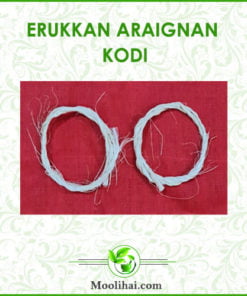
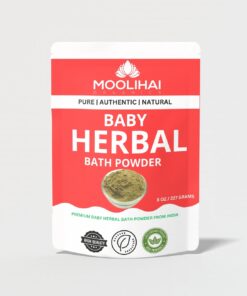
Yes — the Urai Marunthu set is part of a broader traditional Tamil baby care system. Moolihai offers several complementary products: Children’s Herbal Massage Oil — for daily baby massage (a cornerstone of Tamil infant care, promoting bone strength, circulation, and sleep). Baby Herbal Bath Powder — the traditional alternative to soap, made from natural cleansing herbs that are gentle on infant skin. Erukkan Araignan Kodi — the traditional protective cord tied on the baby’s wrist or waist. Uchi Podi (Rasnadi Powder) — an herbal powder applied to the baby’s fontanelle (soft spot) for respiratory and sinus support. Together, these products form the complete traditional Tamil Siddha baby care protocol: internal herbs (Urai Marunthu) + external massage oil + herbal bath + protective cord + fontanelle powder. Each addresses a different aspect of infant wellness.
*Disclaimer: Urai Marunthu is a traditional Tamil baby care herbal kit based on centuries of Siddha medicinal practice. The uses described are based on traditional knowledge and observational experience. This product has not been evaluated by the United States Food and Drug Administration, European Medicines Agency, or Indian Medical Association. It is not intended to diagnose, treat, cure, or prevent any disease. Infants have developing immune and digestive systems — always consult your paediatrician or a qualified Siddha practitioner before administering any herbal preparation to babies or young children. Use in tiny, age-appropriate doses only. If your baby shows any adverse reaction (rash, vomiting, excessive crying, unusual behaviour), discontinue immediately and consult a doctor. Vasambu (Sweet Flag) is particularly potent — use in smaller quantities than other herbs. Not a substitute for medical treatment of infant illness. Individual responses may vary. Keep all herbs out of reach of unsupervised children.
| Weight | 0.2 kg |
|---|
Be the first to review “Urai Marunthu Set | Traditional Medicine Kit for Babies | Natural Ingredients – 1 Pack”
You must be logged in to post a review.
Related products




Reviews
There are no reviews yet.